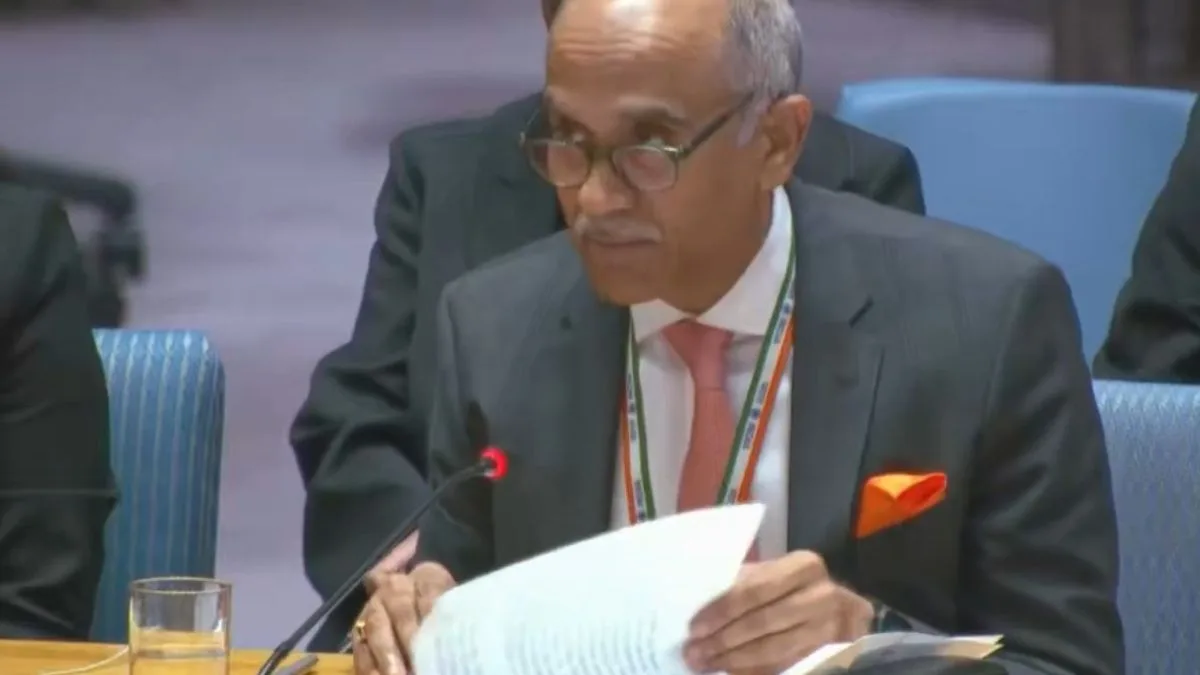
India on Monday accused Pakistan of fostering an environment of institutionalised hostility against its neighbour, telling the United Nations Security Council that anti-India narratives are being deliberately cultivated to serve the interests of Pakistan’s powerful establishment.
Addressing a Security Council discussion on Afghanistan, India’s Permanent Representative to the UN, P Harish, said Pakistan’s attempts to project India as the source of its troubles were aimed at diverting attention from its own political and economic challenges. He asserted that such efforts were unlikely to find credibility internationally.
Advertisement
The remarks came as India sharply criticised Pakistan’s reported decision to describe certain groups operating within its territory as “Fitna al Hindustan”, calling the terminology an example of state-backed misinformation wrapped in religious language. According to India, the move reflects a broader pattern of promoting narratives that encourage hostility towards India among Pakistani citizens.
Harish said the phenomenon stemmed from what he described as an organised campaign driven by Pakistan’s deep state. According to him, such messaging helps keep public attention away from pressing domestic concerns while reinforcing the hold of powerful institutions over the country’s political system and national resources.
“This is an outcome of an organised factory of hate coming from the deep state of Pakistan, which aims to keep their citizens in a state of permanent hostility with India in order to perpetuate their stay in power and control of national resources and distract them from core political and economic problems”.
“Blaming neighbours for its own failures is an old Pakistani habit. This attempt to hoodwink the world will fail,” Harish told the Council.
India links anti-India narrative to Pakistan’s power structure
The Indian envoy also referred to Pakistan’s military establishment, suggesting that its influence over the country’s governance had become more entrenched in recent years.
Harish pointed to constitutional changes introduced last year, saying they represented the latest example of the military consolidating its authority within Pakistan’s political structure.
His remarks appeared to reference the constitutional amendment passed in November, which India said strengthened the position of Pakistan’s military leadership, including Army Chief Field Marshal Asim Munir.
Call for global action against terrorism
During the discussion, Harish also urged the international community to strengthen cooperation against terrorist organisations operating in the region.
He said coordinated global efforts were necessary to ensure that groups such as the Islamic State, Al Qaeda, Lashkar-e-Tayyiba (LeT), Jaish-e-Mohammed (JeM), and affiliated organisations were prevented from carrying out cross-border terror activities.
Harish specifically referred to The Resistance Front (TRF), which India identifies as a proxy of LeT. The group had claimed responsibility for the attack in Pahalgam in April last year that left 25 people dead, including 24 Hindu tourists and one Christian visitor.
He stressed that action was needed not only against terrorist organisations but also against networks and individuals facilitating their operations across borders.